How Long Should You Be Able to Run Without Stopping? A Guide by Age

- EXPLORE FURTHER: According to specialists, how many sit-ups should one be capable of performing at their age?
Curious about assessing the strength of your heart compared to others your age?
There’s no need to undertake complex tests, such as sprinting on a treadmill at maximum speed while covered in various monitors.
Rather than focusing on distance, try running for 12 minutes and see how far you travel. Alternatively, you could walk briskly or jog during this time.
The official name of this scientific instrument is The Cooper Test, which is intended to assess the amount of oxygen your body consumes during exercise, referred to as VO2 max.
The greater your VO2 max, the better your heart is reportedly pumping blood to your organs and tissues, suggesting that these bodily systems are functioning well.
Research indicates that individuals who possess a high VO2 max relative to their age are at a reduced risk of dying from cardiovascular diseases compared to those with lower values.
The test was created by American physician Kenneth Cooper in 1968, with the initial purpose of assessing cardiovascular endurance within the U.S. armed forces.
This can be done on a treadmill, a running track, or any solid and even surface.

You sprint, trot, or briskly walk continuously for 12 minutes and use an app like Strava or Apple Health to monitor the distance you travel in meters.
A results chart posted on the fitness site Very Well Fit discloses the ranges deemed as excellent, above average, average, below average, and poor.
The data is divided based on gender and age up to 50 years old.
Men in their thirties ought to complete 1.9 kilometers (1.1 miles) running, whereas women of the same age should aim for about 1.7 kilometers, which is approximately one mile.
If a man can run 2.6 kilometers, which is about 1.6 miles, when he’s in his 30s, his VO2 max is deemed ‘excellent’. Similarly, women in this age group who complete 2.5 kilometers or roughly one and a half miles also achieve an ‘excellent’ VO2 max rating.
For those entering middle age, the standard is slightly less demanding. A typical man in his 50s should aim to walk nearly a mile, or about 1.6 kilometers, within 12 minutes. Should he manage to complete 2.4 kilometers, which is equivalent to a mile and a third, his achievement would be considered 'outstanding.'
For women in their 50s, covering an average of 0.8 miles or approximately 1.4 kilometers is typical, whereas achieving more than 2.2 kilometers or over one mile indicates exceptional performance.
Any value falling between 1.1K and 1.6K is seen as inadequate, varying according to different age groups.
| AGE | EXCELLENT | ABOVE AVERAGE | AVERAGE | BELOW AVERAGE | POOR |
|---|---|---|---|---|---|
| Male 20-29 | over 2800 metres | 2400-2800 metres | 2200-2399 metres | 1600-2199 metres | under 1600 metres |
| Females 20-29 | over 2700 metres | 2200-2700 metres | 1800-2199 metres | 1500-1799 metres | under 1500 metres |
| Males 30-39 | over 2700 metres | 2300-2700 metres | 1900-2299 metres | 1500-1999 metres | under 1500 metres |
| Females 30-39 | over 2500 metres | 2000-2500 metres | 1700-1999 metres | 1400-1699 metres | under 1400 metres |
| Males 40-49 | over 2500 metres | 2100-2500 metres | 1700-2099 metres | 1400-1699 metres | under 1400 metres |
| Females 40-49 | over 2300 metres | 1900-2300 metres | 1500-1899 metres | 1200-1499 metres | under 1200 metres |
| Males 50 | over 2400 metres | 2000-2400 metres | 1600-1999 metres | 1300-1599 metres | under 1300 metres |
| Females 50 | over 2200 metres | 1700-2200 metres | 1400-1699 metres | 1100-1399 metres | under 1100 metres |
| Source: Verywell fit |
The test doesn’t incorporate scores for individuals above 50 years old; however, older adults are still able to utilize it. digital calculator to calculate their VO2 Max score.
Your VO2 Max score isn’t the sole straightforward metric that determines your health relative to your age.
Experts additionally suggest that the count of push-ups one can perform serves as a reliable marker for assessing both strength and stamina. Research indicates that this measure may reflect life expectancy.
This is due to the fact that the workout targets most of the significant muscle groups across your whole body, encompassing areas such as the legs, abdominals, shoulders, back, and arms.
As per the guidelines from Mayo Clinic, young men should strive for 28 push-ups, whereas women should target 20.
In 10 years when you reach 45, the Mayo Clinic recommends that women should manage to perform 14 push-ups, whereas men should aim for 16.
For individuals aged 55, the number reduces to 10 push-ups for women and 12 for men.
For the eldest age bracket as per the Mayo Clinic, both 65-year-old men and women ought to manage performing 10. push ups at a time.
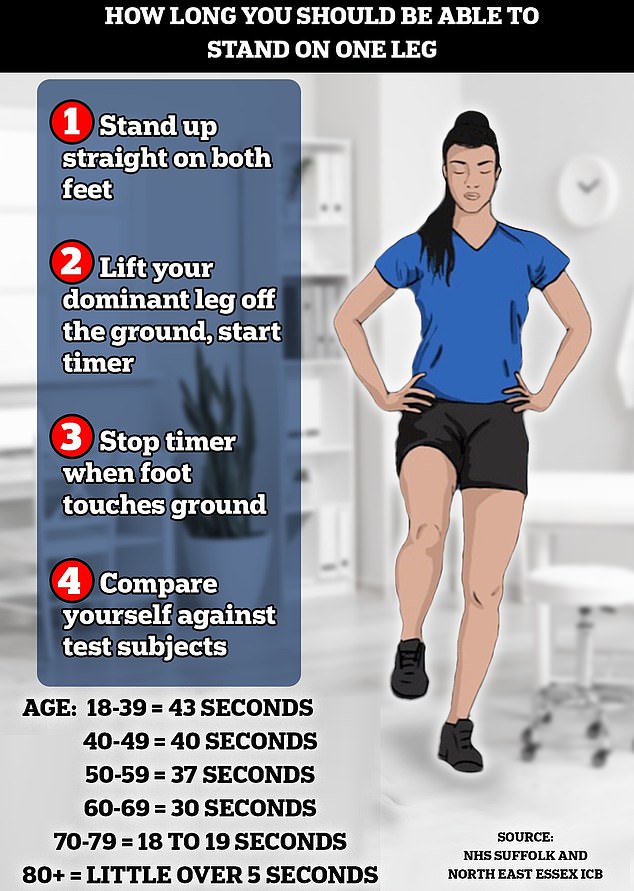
Studies have indicated that elderly individuals capable of standing on one leg for over 10 seconds significantly lower their chances of mortality in the following ten years.
This is due to the fact that a person’s capacity for balancing reflects their overall physical strength and capability to avoid stumbles and falls, an issue that often leads to fatalities among older individuals.
Read more