Taiwan Unveils Home-Built Attack Drone Boat: A New Chapter in Drone Warfare Inspired by Ukraine

Taiwan's The shipbuilding company CSBC Corporation has presented its inaugural domestically produced military unmanned surface vessel (USV). This unveiling represents an important advancement in bolstering the nation's drone armada amid escalating threats from across the sea. People's Liberation Army (PLA).
Inspired by Ukraine’s utilization drone warfare The Endeavour Manta USV corresponds with Taiwan’s approach to asymmetric warfare, utilizing sophisticated and economical technology to counter an opponent with greater numerical strength.
Nevertheless, doubts remain about the effectiveness and cost-efficiency of Taiwan's locally developed military USVs compared to mainland China’s advancements. drone development .
Are you looking for insights into the most significant issues and global developments? Find your answers here. SCMP Knowledge Our latest platform features handpicked content including explainers, FAQs, analyses, and infographics, all provided by our acclaimed team.
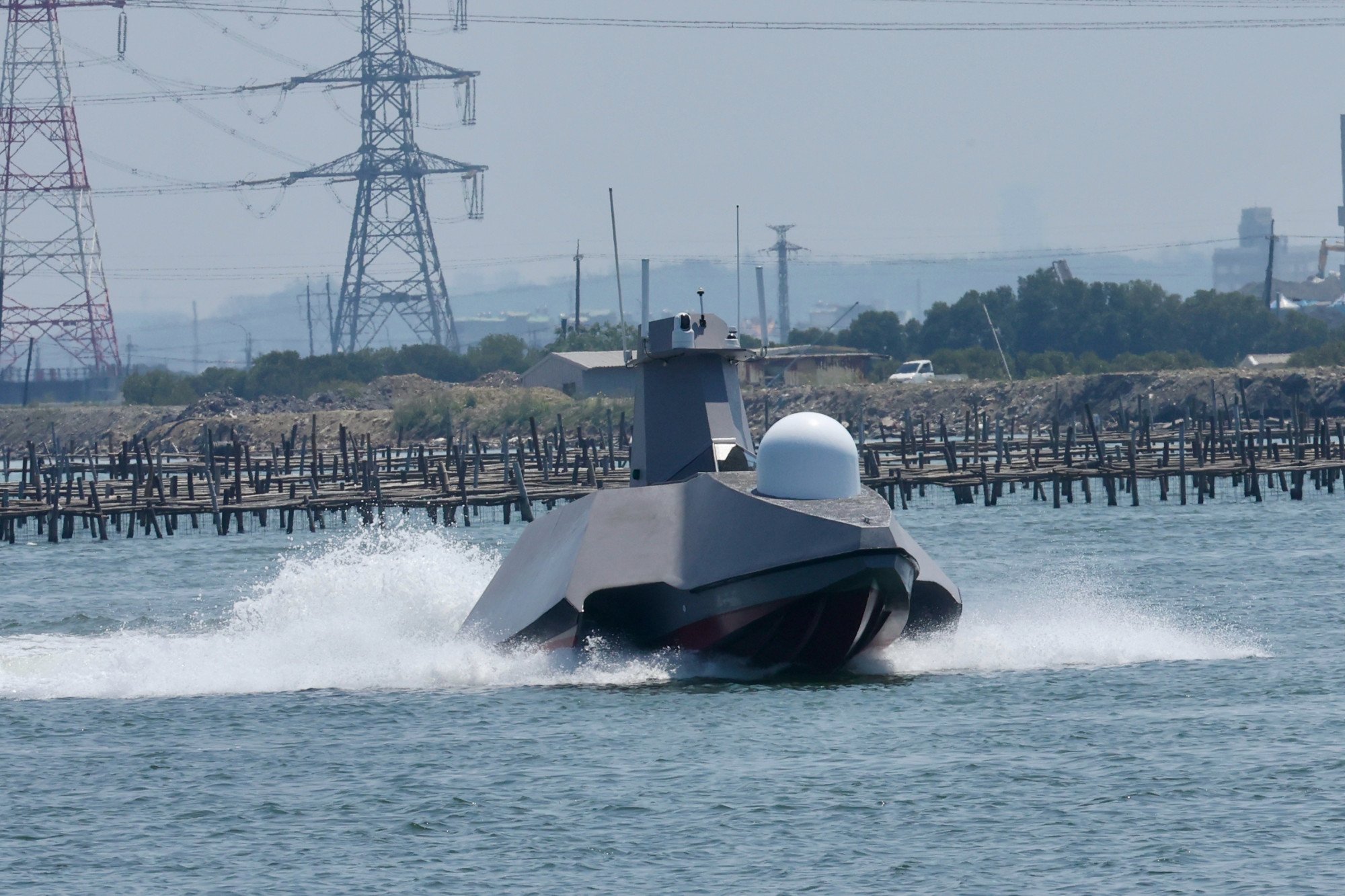
On Tuesday, a new drone assault vessel made its debut at an unveiling ceremony held in Kaohsiung, located in southern Taiwan. This unmanned watercraft spans 8.6 meters by 3.7 meters (equivalent to 28 feet by 12 feet) with a weight over 5 metric tons when fully loaded. Constructed from fiber-reinforced plastic materials, this craft can carry more than one tonne of equipment and reaches speeds up to 35 knots (approximately 65 km/h), driven by dual external motors.
Outfitted with various communication systems such as 4G, line-of-sight radio, and beyond line-of-sight satellite connections, the USV remains connected to a command center.
The CSBC chairperson, Huang Cheng-hung, highlighted the vessel’s AI-powered target acquisition, hijacker deterrence capabilities, and self-guided piloting system, which ensures it can make its way back to home base irrespective of electronic warfare from adversaries. This craft has the capacity to transport explosive payloads and lightweight torpedoes, with potential for severe impact via intentional ramming attacks.
The USV's trimaran hull improves stability in the Taiwan Strait, which is affected by the strong Kuroshio current Huang pointed out that the choppy waters often presented difficulties, emphasizing the importance of seaworthiness. Moreover, the maneuverability of the USV allowed for quick deployment alongside tow trucks at shores or harbors.
Aside from the vehicle’s imported satellite navigation system and engines, every component is manufactured domestically. According to Huang, eliminating the satellite navigation feature might reduce expenses by 45 percent. This drone comes in standard, enhanced, and military versions and can be tailored for both civil and scientific applications. When asked about prices, Huang declined to provide specifics, noting that they fluctuate depending on customer requirements.
CSBC started developing the military-grade unmanned surface vessel (USV) at the beginning of 2024. This initiative coincides with an NT$812 billion (approximately US$24 billion) project led by Taiwan’s premier weapons developer, the National Chung-Shan Institute of Science and Technology (NCSIST). to develop drone boats , with the objective of starting mass production in 2026.
The defense ministry of Taiwan outlined that the USVs should be 10 meters long, with a maximum loaded weight below 4 metric tons and possess a remote operation capability spanning approximately 70 kilometers (or about 43 miles).
Local media reports indicated that the institute's USV supported autonomous navigation and a stealth-optimised hull for surprise strikes. Once designated, it autonomously guides and attacks enemy warships.
The NCSIST aims to finish the combat assessments by the end of this year, with large-scale production anticipated for next year. According to reports, the military desires over 200 units.
The NCSIST plans to conduct an open-sea test in June and has extended invitations to local manufacturers to participate. However, despite this invitation, CSBC, following its independent development trajectory, will not be joining in.
A number of other Taiwanese firms are likewise engaged in the development of military unmanned surface vessels.
During the Taiwan International Boat Show held in December, Thunder Tiger exhibited two assault versions: the Tigershark 200 and Seashark 400, boasting operational distances of 30 kilometers and 150 kilometers correspondingly.
Corum Yachts in Taoyuan unveiled the Piranha-9, a 9-meter-long unmanned surface vessel featuring an 850-kilogram payload capacity along with stealth capabilities. The vehicle can deploy up to four loitering munitions or suicide drones, as stated by the firm.
Taiwan's development of unmanned surface vessels (USVs) has been significantly inspired by Ukraine’s effective deployment of suicide drone boats against Russian naval forces.
Taiwan intends to deploy Unmanned Surface Vehicles (USVs) for surveillance, laying mines, and executing direct attacks to strengthen its maritime defense amid China’s increasing military activities around the island.
Beijing views Taiwan as an integral part of its domain and hasn’t dismissed the possibility of employing military action to reunify with it. Since William Lai Ching-te became the leader of Taiwan in May, China has intensified its military presence around the island. Lai has consistently maintained that Taiwan and the Chinese mainland do not hold a superior-inferior relationship and referred to Beijing as a “hostile foreign entity.”
Many nations, such as the United States, do not consider Taiwan to be a separate sovereign nation. However, the U.S. continues to pledge support with weapons for defending the island and stands against any effort to seize control of it through military means.
According to observers, Taiwan’s strategic plan included a multi-layered defense strategy where unmanned surface vehicles (USVs), aerial drones, and missile systems were intended to collaborate in order to prevent the People's Liberation Army (PLA) from gaining access to the island’s territorial waters. The deployment of swift, AI-driven drone boats with the capability to attack bigger warships might provide Taiwan a relatively inexpensive method to mitigate the effects of a potential amphibious assault.
Even with their strategic importance, Taiwan encounters numerous obstacles in developing and deploying USVs. Experts emphasize cost-efficiency as a major issue.
"The primary concern is whether Taiwan can produce and deploy these domestic unmanned surface vessels (USVs) at a large scale without overburdening the defense budget," stated Shu Hsiao-huang, a researcher from the military-linked Institute for National Defence and Security Research.
Shu pointed out that Kamikaze USVs ought to be comparatively affordable when contrasted with traditional weaponry; however, those able to endure harsh seas and successfully reach Mainland China would come at a higher price.
He stated that additional testing is required to guarantee seamless integration with naval forces and command systems.
Chieh Chung, who serves as the secretary-general of the Association of Strategic Foresight—a military think tank based in Taipei—stated that Ukraine’s suicide unmanned surface vessels (USVs) have individual costs ranging from $100,000 to $250,000. He also mentioned that Taiwan's versions ought to stay within this price bracket.
"Nevertheless, Taiwan and Ukraine have distinct circumstances," he stated.
Ukraine has the capability to dispatch several unmanned boat drones to attack Russia's Black Sea Fleet stationed in Sevastopol.
On the contrary, according to Chieh, Taiwan was unlikely to employ Unmanned Surface Vessels (USVs) for attacking PLA fleets. These fleets would be positioned in the Western Pacific as part of an anti-access strategy aimed at preventing U.S. intervention during a potential strait crisis. Rather than engaging distant forces, Taiwan ought to utilize USVs close to its coastline with the aim of intercepting and striking back at approaching PLA landing craft.
"If destroying one PLA ship with four or five suicide USVs proves to be a valuable exchange, then it’s worth considering," Chieh stated.
A significant challenge also comes from electronic warfare. The Chinese People's Liberation Army possesses sophisticated cyber and electronic warfare abilities, which could interfere with Taiwan's unmanned surface vessels through signal jamming or digital infiltration.
"Creating countermeasures is essential for maintaining secure and robust communication systems," Chieh stated.
Chen Kuo-ming, who serves as the editor-in-chief of the Chinese-language magazine Defence International, highlighted that Mainland China has already created various types of unmanned ships designed for both surveillance and combat purposes, thereby placing Taiwan at a technological disadvantage.
He stated that the PLA's unmanned surface vessel capabilities significantly surpass those of Taiwan.
Chen encouraged the Taiwanese government to “increase their efforts, such as providing subsidies to domestic producers to speed up the development of USVs,” thereby strengthening the island’s defense posture in anticipation of a possible military confrontation across the strait.
He similarly highlighted the importance of conducting combined military exercises involving unmanned surface vessels (USVs) to evaluate their performance in actual combat situations.
More Articles from SCMP
Hong Kong aims to compete with every Asian city including Singapore to boost tourism: minister
Chinese teenager helps with home delivery, assisted by paramedics via phone when his mother's water broke.
How serving time in Bali turned a Hong Kong TV producer into a yoga instructor
Can China-EU strains be subsiding due to a series of diplomatic efforts from France and the EU?
The article initially appeared on the South China Morning Post (www.scmp.com), which is the premier source for news coverage of China and Asia.
Copyright © 2025. South ChinaMorning Post Publishers Ltd. All rights reserved.