Wedding Wars Escalate: South Korea's Battle Over Refunds and Forced Bundles


At age 32, Lee was set to walk down the aisle soon. Last December, she inked a deal worth approximately $1,600 for an "S·D·M" package from a wedding coordinator, which covers photography, attire, and cosmetics—a common arrangement in South Korea. Her special day is planned for later this year; hence, she booked these services ahead of time, one full year prior. Unfortunately, under unexpected conditions, she sought termination of the agreement along with reimbursement. Nevertheless, the firm rejected her plea stating they couldn’t accommodate cancellations since processing had commenced, even though only nine months remained until her nuptials.
I had only put down the deposit. We hadn't even talked about the particular services I was supposed to receive, and I've never actually gone to their office," Lee stated. "Yet they insist that the order has already been processed.
There has been a growing number of reports about refusals to issue refunds and mandatory bundling of products and services related to weddings and event spaces. Many clients find themselves unable to obtain reimbursement for inferior offerings, such as low-quality photography sessions. Given that weddings are frequently seen as one-time occasions, certain businesses seem to take advantage of this sentiment by delaying responses and declining to engage in discussions over these issues.
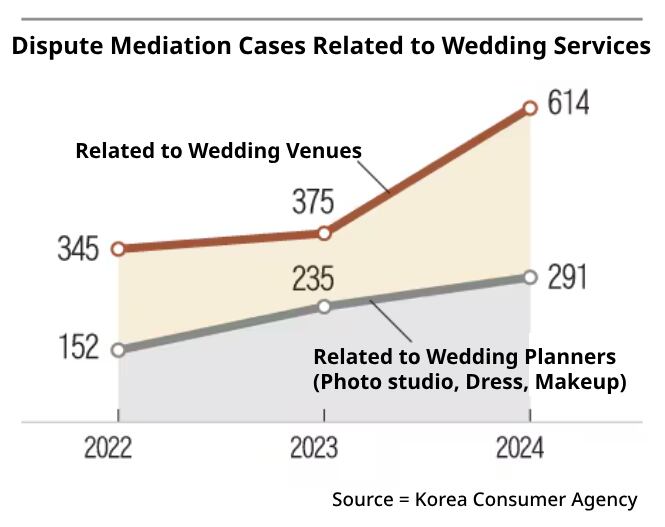
The Korea Consumer Agency reported on April 28 that the number of complaints about wedding service packages more than doubled within two years, increasing from 152 instances in 2022 to 291 in 2024. Similarly, grievances concerning wedding venues escalated dramatically, jumping from 345 cases in 2022 to 614 in 2024.
Kim, another 32-year-old bride-to-be, said she signed a 1.8 million won ($1,300) S·D·M package with a wedding planner during a bridal fair in February. On her way home the same day, she regretted the decision and called the company about five hours later to request a refund of the 300,000 won ($220) deposit. The company refused, citing internal policy.
However, under South Korea’s Door-to-Door Sales Act, consumers are entitled to full refunds if they cancel within 14 days when a contract is signed at a fair. Online contracts are protected under the Electronic Commerce Act, which allows for cancellations within seven days. Kim ultimately recovered the full deposit through the Korea Consumer Agency’s dispute resolution process.
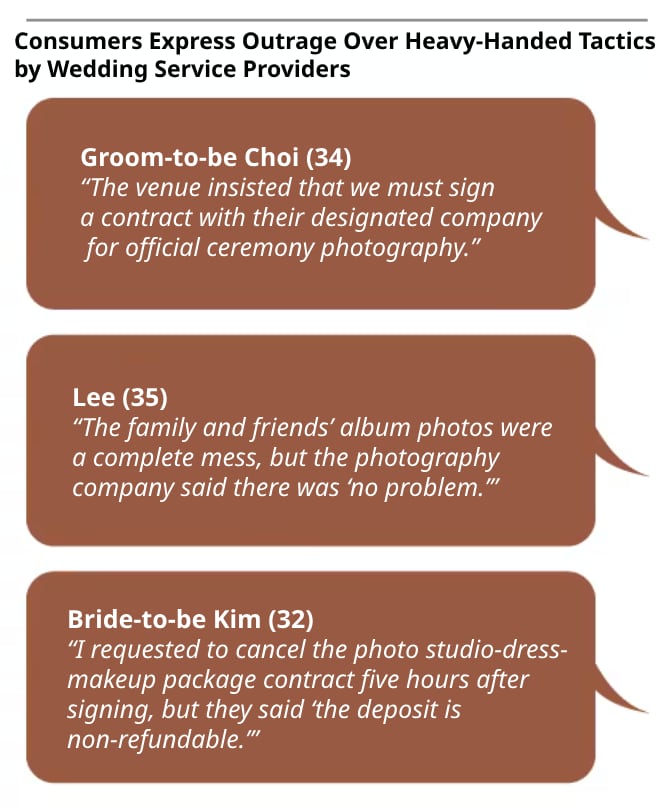
Sometimes, sellers allegedly stop communicating altogether once refund requests are submitted. Choi, who is set to marry at age 33, mentioned that he had agreed to lease a traditional Korean wedding dress (hanbok) from a company at a bridal fair last year. However, after deciding to cancel three days post-contract, his attempts to get a refund were unsuccessful as they claimed one couldn’t be provided. Following this response, the business ceased answering his phone calls completely.
Bundled sales and subpar service quality remain persistent problems. A wedding venue in Seoul’s Seocho District requires clients to purchase photography services, wine, and piano performances as “mandatory options” when booking a ceremony. Other venues similarly mandate fees for amenities such as pyebaek spaces designated for customary post-nuptial ceremonies, or for "petal tosses," where attendees shower the couple with flower petals throughout the parade.
Kim, aged 31, who is getting ready for her wedding later this year, mentioned that she wished to skip the pyebaek The ritual took place, yet she was informed by the venue that she must still cover the cost of the room despite not utilizing it. "I considered objecting," she mentioned, "however, considering this is a once-in-a-lifetime occasion, I agreed reluctantly, fearing that voicing concerns could impact the ceremony."
Criticism of photography studios often centers around their pushy bundle deals. Many won’t book photo sessions unless customers buy supplementary products like albums or framed photos. Additionally, some charge extra for standard offerings, insisting these come with obligatory fees—such as for unedited and edited digital images. Various providers add charges for outdoor or evening shots just to hike up the total cost.
Despite disruptions caused by service failures during their weddings, compensation is uncommon. Lee, a 35-year-old bridegroom who got married last year, mentioned that he continues to feel disappointed whenever he looks at his wedding photographs. The group pictures featuring family and friends were inadequately organized, and numerous images appeared skewed.
"The firm stated that they empathize with our situation; however, since the photographs were legally captured, they claimed they couldn't provide a refund or any sort of compensation," Lee explained.